
Using and Building Terraform Modules on Google Cloud
Using and Building Terraform Modules on Google Cloud
Timeline: December 2025
Role: Cloud Engineer / Infrastructure Engineer
Skills: Terraform, Terraform Modules, Google Cloud, VPC, Cloud Storage, Infrastructure as Code (IaC), Module Inputs and Outputs, Reusable Infrastructure
Project Summary
This project focused on using Terraform modules to improve infrastructure organization, reusability, and consistency on Google Cloud. The work involved first consuming a published module from the Terraform Registry to provision a VPC network with multiple subnets, and then designing a custom local module to provision a Cloud Storage bucket configured for static website hosting.
The implementation demonstrated how Terraform modules help structure Infrastructure as Code into reusable, encapsulated components, making complex environments easier to maintain, standardize, and scale across teams and projects.
Objectives
- Use a Terraform module from the Registry
- Configure module input variables
- Consume module output values
- Build a reusable local Terraform module
- Provision Cloud Storage resources through a custom module
- Structure Terraform code for modularity and reuse
- Apply Terraform module best practices for maintainability
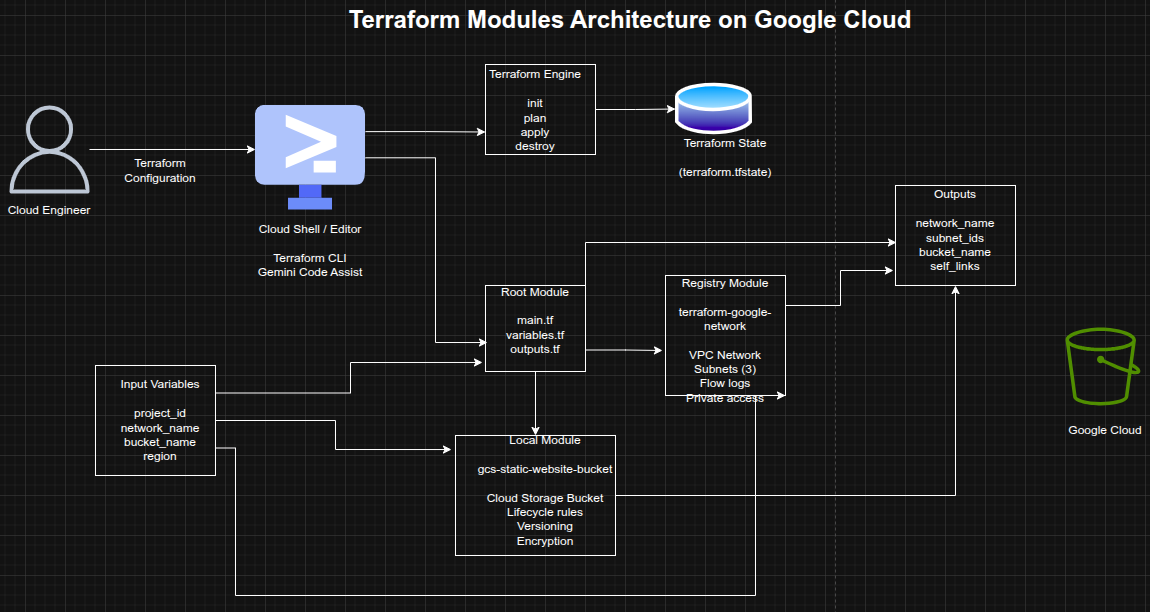
Architecture Overview
The architecture consisted of:
- A root Terraform configuration orchestrating module usage
- A Registry VPC module used to provision:
- a custom VPC network
- multiple subnets
- subnet-level configuration such as private access and flow logs
- A local Terraform module (
gcs-static-website-bucket) used to provision:- a Cloud Storage bucket
- lifecycle rules
- versioning
- retention and encryption options
- variables.tf and outputs.tf files used to define module inputs and outputs
- Uploaded HTML objects hosted in the bucket for static website access
Implementation & Highlights
1. Using a Registry Module
- Cloned the Google Terraform Network module example project
- Used the published
terraform-google-modules/network/googlemodule - Configured a custom VPC with three subnets
- Enabled subnet-level options such as:
- private Google access
- flow logs
- logging configuration
- Provisioned infrastructure using
terraform initandterraform apply
2. Defining Root Input Variables
- Configured root variables for:
project_idnetwork_name
- Replaced hardcoded values with variables for flexibility and reuse
- Updated subnet regions and module arguments to align with the lab environment
3. Consuming Module Outputs
- Exposed and reviewed module outputs including:
- network name
- network self-link
- subnet names
- subnet CIDR ranges
- subnet regions
- flow log settings
- Used outputs to make provisioned infrastructure easier to reference and validate
4. Cleaning Up Managed Infrastructure
- Destroyed the module-provisioned VPC resources using
terraform destroy - Removed the downloaded example module directory
- Reinforced safe lifecycle management for Terraform-based infrastructure
5. Building a Local Terraform Module
- Created a reusable local module directory:
modules/gcs-static-website-bucket
- Added module files:
website.tfvariables.tfoutputs.tfREADME.mdLICENSE
- Structured the module according to Terraform module best practices for maintainability and sharing
6. Implementing the Storage Bucket Module
- Defined a Cloud Storage bucket resource inside the local module
- Added support for:
- versioning
- labels
- force destroy
- retention policies
- encryption
- lifecycle rules
- Designed the module to be reusable and configurable through inputs rather than hardcoded values
7. Exposing Module Outputs
- Added outputs for the created bucket resource
- Returned module-created infrastructure to the root module through outputs
- Reinforced Terraform’s modular composition pattern for passing resource attributes between layers
8. Calling the Local Module from the Root Module
- Referenced the local module from the root configuration using:
source = "./modules/gcs-static-website-bucket"
- Passed input variables such as:
- bucket name
- project ID
- location
- lifecycle rules
- Initialized and applied the configuration to provision the bucket
9. Uploading Static Website Content
- Downloaded sample HTML files
- Uploaded them to the provisioned storage bucket
- Accessed the hosted files using the bucket URL
- Demonstrated how the custom Terraform module could support static website hosting use cases
10. Final Cleanup
- Destroyed the bucket and related Terraform-managed resources
- Completed the full lifecycle from module consumption and creation through cleanup
Design Decisions
- Used a published Registry module to accelerate VPC deployment and apply community-tested patterns
- Used a local custom module to demonstrate reusable internal infrastructure design
- Defined input variables to keep configurations flexible and reusable
- Used outputs to expose provisioned resources cleanly between modules
- Added README and LICENSE files to align with module-sharing best practices
- Included lifecycle rules, retention, and encryption hooks to make the bucket module extensible for real-world use
Results & Impact
- Successfully consumed a Terraform Registry module for VPC provisioning
- Successfully built and used a custom local Terraform module for Cloud Storage
- Demonstrated practical use of:
- module reuse
- encapsulation
- variables
- outputs
- modular code structure
- Strengthened understanding of how Terraform modules improve scalability, consistency, and maintainability in Infrastructure as Code projects
- Built a strong foundation for designing reusable internal Terraform modules for team and enterprise use
Tools & Technologies Used
- Terraform – Infrastructure as Code engine
- Terraform Registry – Published module source
- Google Cloud VPC – Network provisioning
- Cloud Storage – Static website bucket hosting
- Terraform Modules – Reusable infrastructure abstraction
- Cloud Shell / Editor – Terraform execution and editing environment
Outcome
This project demonstrates the ability to both consume and build Terraform modules on Google Cloud. It highlights practical skills in modular Infrastructure as Code design, reusable cloud provisioning, variable-driven configuration, and output-based composition, which are highly relevant to cloud engineering, DevOps, and platform engineering roles.